NASA's checked its space rock maths and it's not good news
The Register
NASA has revealed fresh research on the Chelyabinsk meteorite that exploded over Russia in February, and the findings aren't good: not only does it look like the astronomic models about the number of similar-sized things reaching Earth are wrong, but also the damage they can do is much greater than expected.
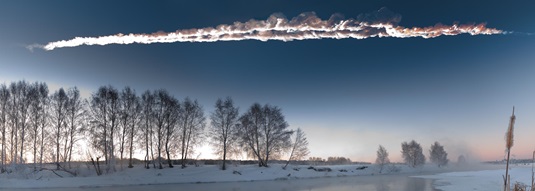
Is it a bird? Is it a plane? No, it's a big chunk of rock. Credit: M. Ahmetvaleev
"Over the past few decades we've seen an impact rate about seven times greater than the current state of the telescopic surveys would indicate."
Cooke said that as the current state of asteroid surveys was expanded he expected we would find more meteorites in the vicinity to account for these impacts, but also that the amount of damage they caused was being reassessed.
The nuclear model used to estimate the amount of explosive force such incidents could cause had, in fact, been over estimating the blast impacts of such air-bursting meteors, he explained. But the amount of heat they generate, and the damage caused by the shockwave of air they push before them as they come down through the atmosphere, was significantly underestimated.
The Chelyabinsk meteor is the largest foreign body to come down to Earth since the Tunguska event in 1908, where a comet or meteor devastated 2,150 square kilometers of Siberia with an airburst, according to Lindley Johnson, NEO program executive of NASA's planetary science division.
Thanks to the amount of dashcam videos, smartphones with cameras, the work of "citizen scientists," and boffins around the world sharing their data, NASA has now piece together exactly what happened during the Chelyabinsk event he explained.
The meteorite arrived completely unexpectedly because it was coming at Earth with the Sun behind it, masking its progress NASA said. It hit our atmosphere at a speed of 42,500 mph (19 kilometers per second) and the vast majority of its mass was destroyed in the detonation 23 kilometers above Russia.
Around 9,000 to 13,000lb (4,000 to 6,000 kilograms) of the meteor survived the blast and fell to Earth, including several chunks that have been recovered. From an analysis of the remains scientists have concluded that fractures in the meteorite (formed from an impact with another space rock) left veins of silicates running throughout its body, making it much more likely to break up in the friction with our atmosphere.
Read more about Another Devastating Chelyabinsk Meteor Strike: '7x As Likely' As Thought

No comments:
Post a Comment